
ExampleFor consultants · Dashboards
A consultant builds a client's apps from his own business account
An IT consultant who looks after several small businesses
A one-person IT consultancy builds a job tracker and a weekly overview for a print shop. The shop gives him access with a code, and can take it away again.
This is an example. The business is made up to show what BurrowHub can do today — it is not a customer, and nothing here is a customer's words or results.
- Their data
- The consultant's partner code
- Print jobs
- BurrowHub's AI
Builds the app from what they asked for
- The appJob tracker
- Jobs
- This week
- Who uses it
- The consultant, who builds it
- The shop's staff
The situation
The consultant already helps a print shop with its computers. The shop wants a way to track print jobs and see the week's work at a glance, but nobody there has time to build it, and the owner doesn't want to hand out her password.
What they asked for
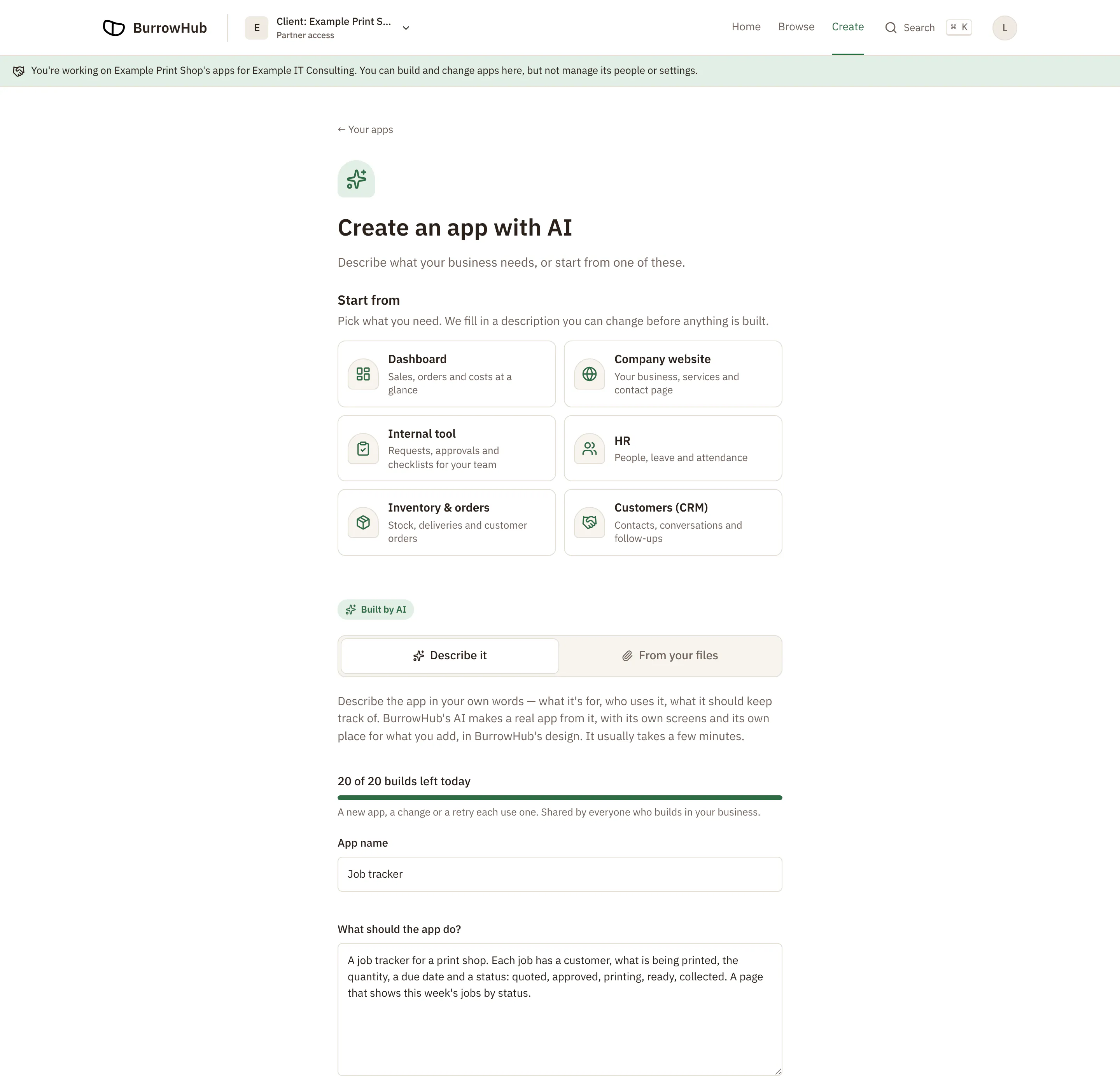
A job tracker for a print shop. Each job has a customer, what is being printed, the quantity, a due date and a status: quoted, approved, printing, ready, collected. A page that shows this week's jobs by status.
In their own words, as they'd type it into Create with AI.
What BurrowHub built
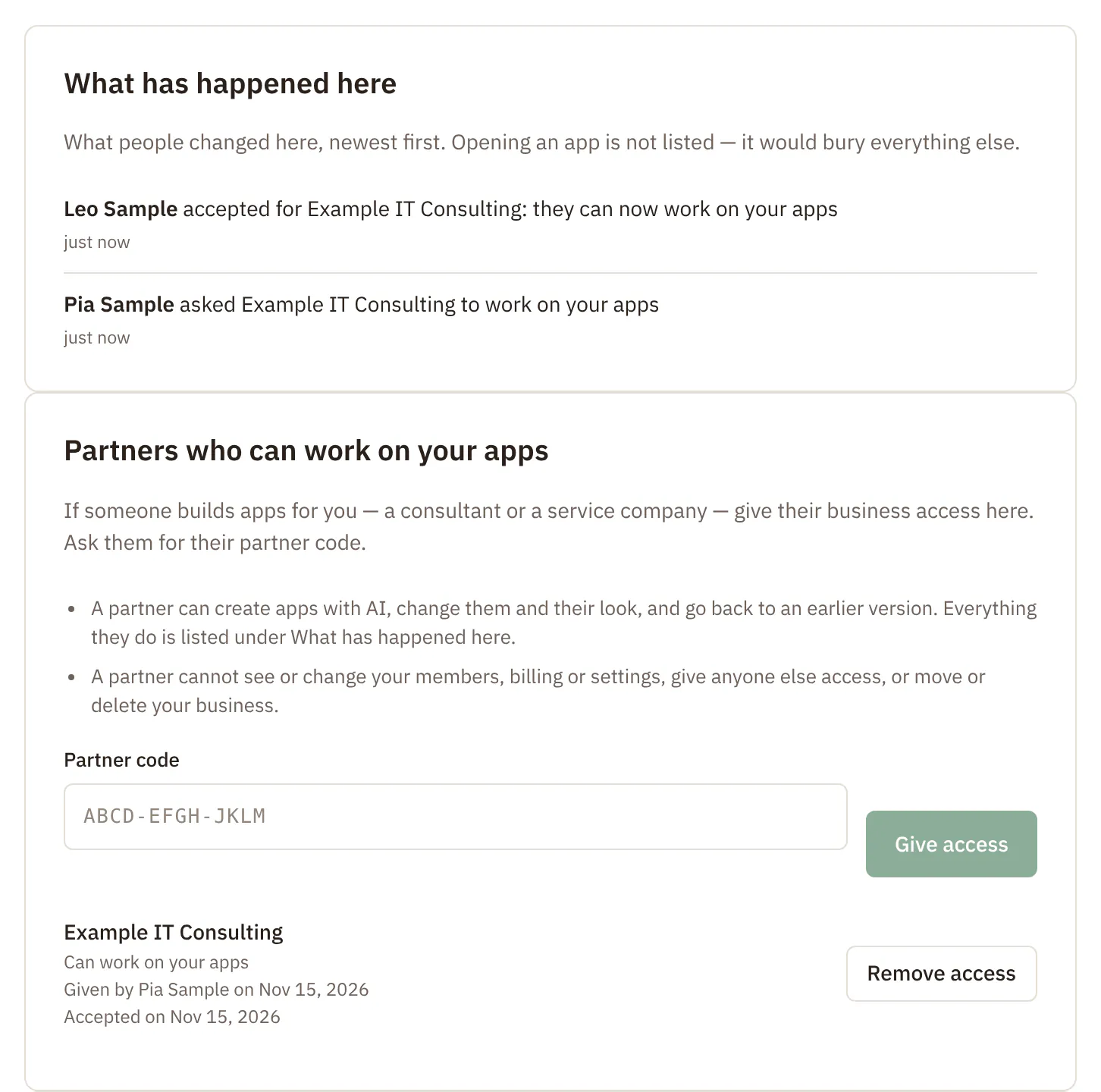
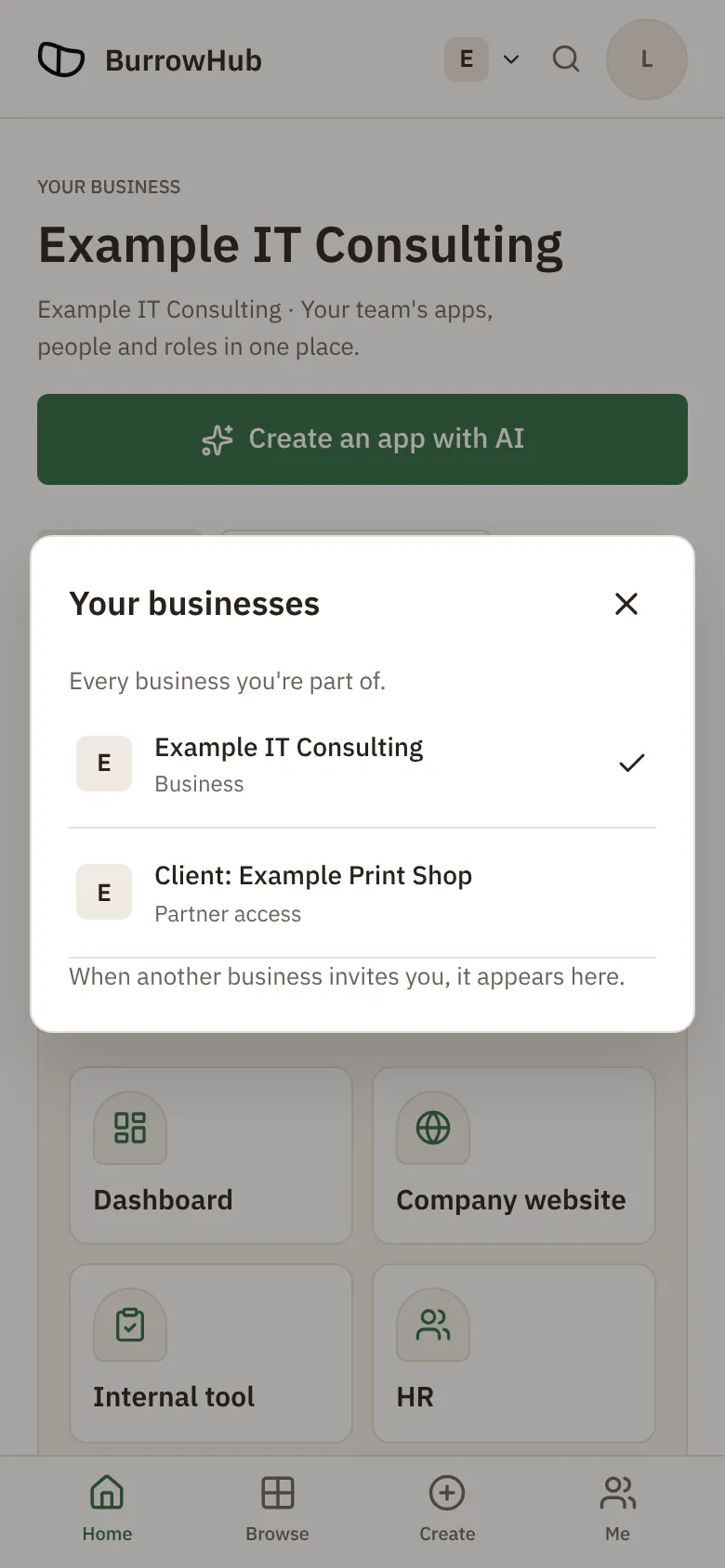
The consultant has his own BurrowHub business. He gave the shop his partner code; the owner typed it in, he accepted, and the shop appeared in his switcher, marked as a client. He built the app there, inside the shop's business.
Screens
- Jobs: every print job with its customer, quantity, due date and status
- This week: jobs due this week, grouped by status
Data
- The jobs, kept by the app inside the shop's business — not the consultant's
The steps in BurrowHub
Real BurrowHub screens, filled with made-up data for this example — the business, the people and the figures are invented. They show how it was set up, not the finished app. The screens are in English.
 Open the full-size picture
 Open the full-size picture
 Open the full-size picture
How they use it
- The shop's staff use the job tracker on the counter computer and on their phones.
- When the owner asks for a change, the consultant makes it in the Build with AI chat, tries it in the preview and publishes it — or restores the earlier version if it isn't right.
- The shop's activity list shows what he did, marked as a partner from his business.
- The owner can remove his access at any time; his ways into the shop's apps end with it.
What it doesn't do yet
- The consultant can't invite people, change the shop's brand kit, change who can open an app, list an app in Browse or delete one. The shop's owners and admins do that.
- If the shop connects its own spreadsheets, the consultant sees their names and columns so he can build with them — never the rows.
- BurrowHub doesn't handle billing between the consultant and the client.
BurrowHub features in this story
- Consultants (partners)
- Build with AI by chatting
- Preview, then publish
- Versions you can restore
- People and roles
Want an app like this for your business?
Tell us a little about your business and what you need, and we'll get back to you.
More examples
- An independent bakery with three shops
A sales dashboard that reads the shops' own spreadsheets
Each shop already kept a weekly sales sheet. The owner wanted one page that showed all three, without copying numbers by hand.Read the story - A small tea wholesaler with a warehouse team of five
Stock and orders in one place, with a warning when stock runs low
Orders came in by phone and email, and stock lived in a spreadsheet. The team wanted one list they could all keep up to date from the warehouse floor.Read the story - A dental clinic with about fifteen staff
Leave requests, and a checklist for every new starter
Leave was asked for on paper, and new starters were set up from memory. The practice manager wanted both in one app the staff could use on their phones.Read the story