
ExampleInternal tools
A customer list in the company's own look, in each person's language
A cleaning company whose team speaks several languages
The office works in Japanese and English; some cleaners read Indonesian or Traditional Chinese more easily. They wanted one customer app everyone could read on their phones.
This is an example. The business is made up to show what BurrowHub can do today — it is not a customer, and nothing here is a customer's words or results.
- Their data
- Customer details
- Brand kit and guidelines
- BurrowHub's AI
Builds the app from what they asked for
- The appCustomers
- Customers
- Customer page
- Today
- Who uses it
- The office
- Cleaners, in four languages
The situation
The company keeps its customers — offices and flats — in a spreadsheet, with the address, how to get the key and notes about each place. Cleaners phone the office to ask, and some of them read Indonesian or Traditional Chinese more easily than Japanese or English.
What they asked for
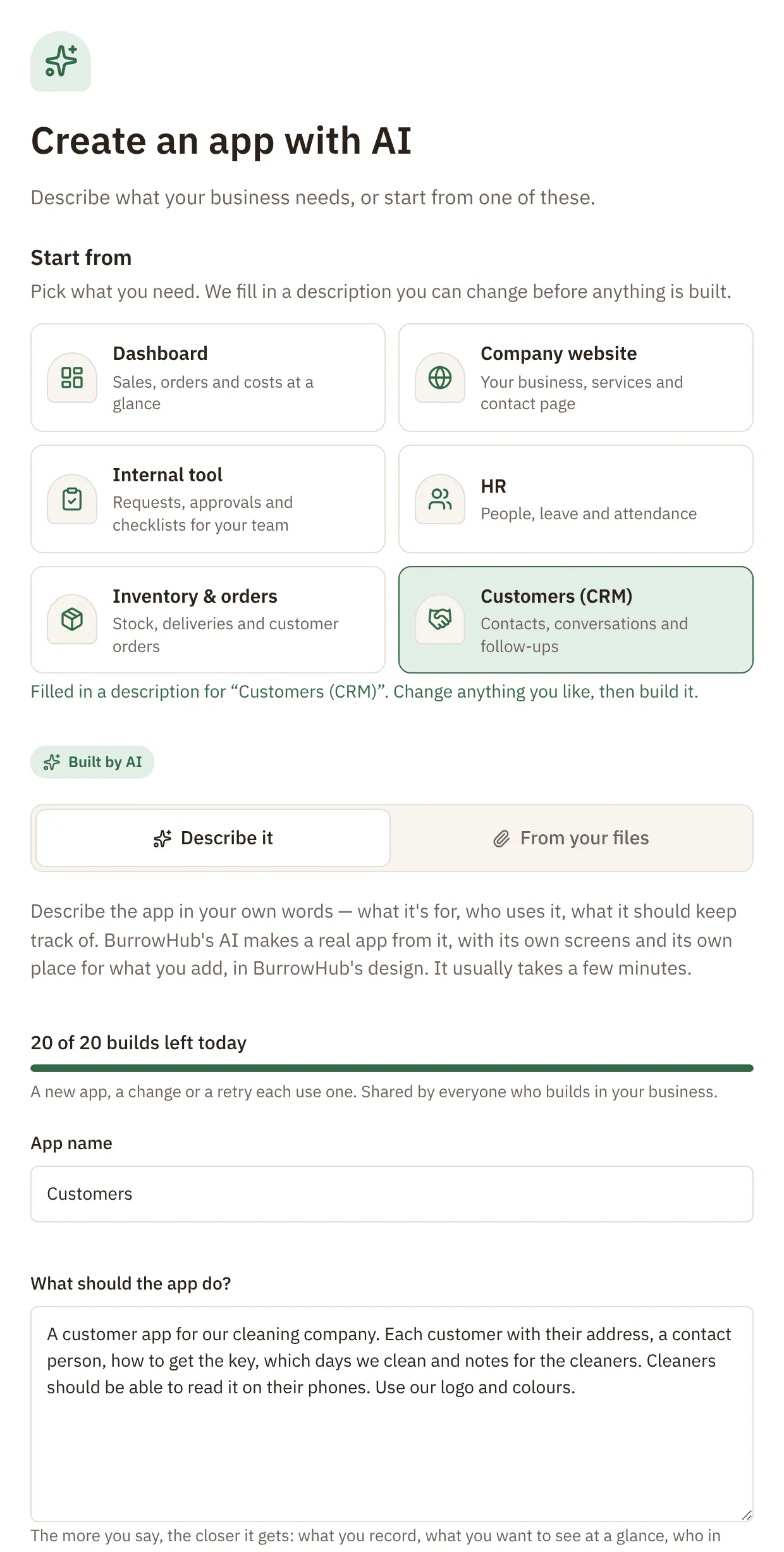
A customer app for our cleaning company. Each customer with their address, a contact person, how to get the key, which days we clean and notes for the cleaners. Cleaners should be able to read it on their phones. Use our logo and colours.
In their own words, as they'd type it into Create with AI.
What BurrowHub built
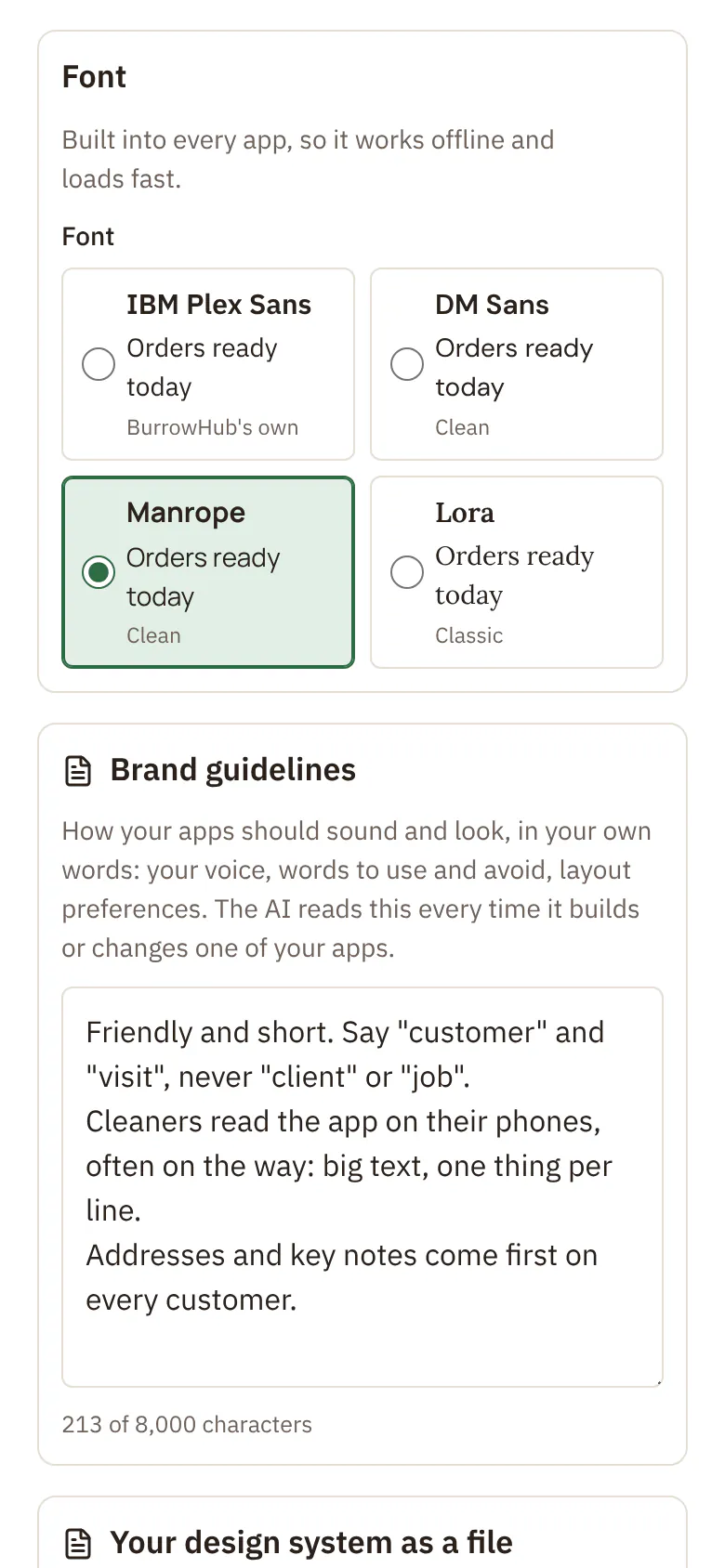
The company's logo, colours and a few lines about how it likes to sound were already in its brand kit, so the app was built in that look. Like every app BurrowHub builds, it speaks English, Japanese, Traditional Chinese and Indonesian.
Screens
- Customers: a list the team can search, with the days each place is cleaned
- Customer page: address, contact, how to get the key, and notes for the cleaners
- Today: the places to clean today
Data
- The customer details, which the office entered into the app
- The brand kit: logo, colours, font and the company's own guidelines
The steps in BurrowHub
Real BurrowHub screens, filled with made-up data for this example — the business, the people and the figures are invented. They show how it was set up, not the finished app. The screens are in English.
 Open the full-size picture
 Open the full-size picture
How they use it
- Each person sees the app's screens in the language they chose in BurrowHub, or the one BurrowHub picks for them.
- The office keeps the notes up to date on the computer; cleaners read them on their phones before they arrive.
- When the office asked for the Today page in the chat, the first version listed places in an order they didn't want. They restored the earlier version and asked again, more clearly.
What it doesn't do yet
- Notes people type are not translated; only the app's own words are.
- It does not plan routes or send customers messages.
- It does not connect to accounting or invoicing software.
BurrowHub features in this story
- Starting points
- Brand kit
- Four languages
- Build with AI by chatting
- Versions you can restore
- Works on phones
Want an app like this for your business?
Tell us a little about your business and what you need, and we'll get back to you.
More examples
- An independent bakery with three shops
A sales dashboard that reads the shops' own spreadsheets
Each shop already kept a weekly sales sheet. The owner wanted one page that showed all three, without copying numbers by hand.Read the story - A small tea wholesaler with a warehouse team of five
Stock and orders in one place, with a warning when stock runs low
Orders came in by phone and email, and stock lived in a spreadsheet. The team wanted one list they could all keep up to date from the warehouse floor.Read the story - A dental clinic with about fifteen staff
Leave requests, and a checklist for every new starter
Leave was asked for on paper, and new starters were set up from memory. The practice manager wanted both in one app the staff could use on their phones.Read the story